Beyond the Office Walls: How Remote Work is Reshaping Our Local Communities
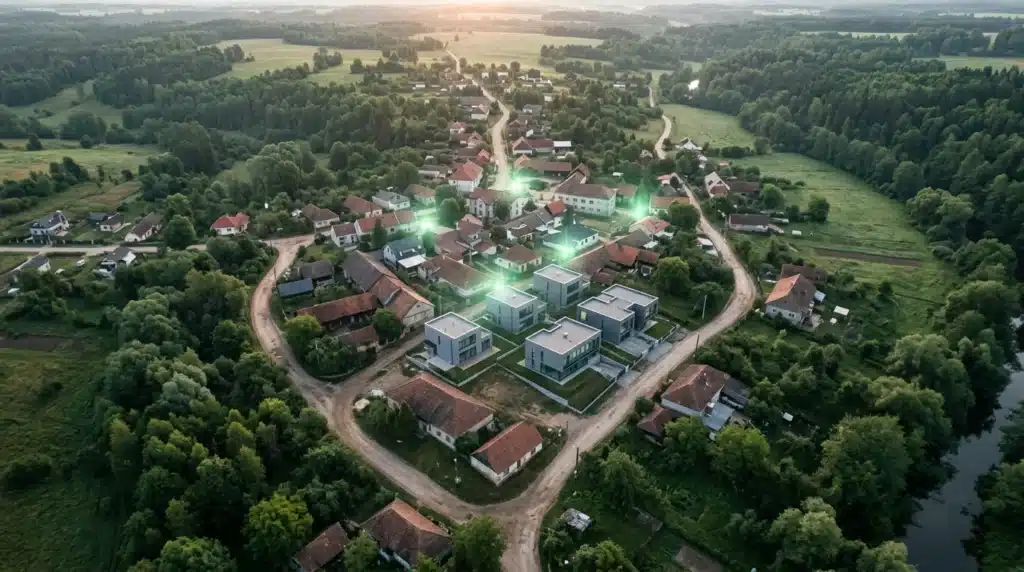
The morning commute, the downtown lunch rush, the 5 p.m. exodus from city centers—for generations, these rhythms defined not just our workdays, but the very geography of our lives. That era is decisively ending. The shift to remote work has severed the century-old link between career and location, triggering a quiet but massive redistribution of people, capital, and daily life across the country.
This is far more than a simple change in office policy; it’s a underlying re-shuffling of American society. As millions of workers trade city skylines for small-town main streets, they are rewriting the economic and social rules for communities large and small. This migration brings a surge of new income and energy to once-overlooked areas, but it also introduces complex pressures on housing, infrastructure, and the existing social fabric.
What happens when the ‘laptop class’ moves in next door? This article explores the profound impact of remote work on communities, moving beyond the home office to examine the real-world consequences. We will dissect the economic boom that revives local businesses while simultaneously fueling gentrification, investigate the social paradox of being more physically present but potentially more isolated, and analyze the immense strain this new reality places on public services that were built for a different world.
The Great Dispersion: Redefining ‘Local’ in a Remote Era
The tether to a physical office has snapped, and with it, our entire concept of ‘local’ is unraveling. For generations, professional life dictated geography, forcing millions to cluster in expensive urban hubs. Now, with the rise of distributed work, we are witnessing a population redistribution not seen in nearly a century, fundamentally challenging what it means to belong to a community.
This is more than just a trend. It’s a geographical reckoning.
Data from a recent Brookings Institution analysis supports this shift, revealing that mid-sized cities saw a net population inflow of 3.7% from major metropolitan areas over the last reporting period. This migration isn’t simply a flight to the suburbs; it’s a deliberate uncoupling of career from location. What defines a neighborhood when your neighbors are digitally commuting to jobs in three different time zones? The impact of remote work on communities is creating a new social fabric, governed by a different set of unseen threads in our social dynamics.
The daily commute once acted as an anchor, defining the radius of our lives. Your ‘local’ coffee shop, grocery store, and social circle were all contained within that geographic bubble. Now, for a growing number of people, that anchor is gone. The result is the rise of “Zoom towns” and digitally-native communities that exist both everywhere and nowhere at once, creating a complex new reality—and it’s not just for idyllic mountain towns anymore. This dispersion forces us to question who benefits and who gets left behind.
This geographic reshuffling is not a temporary adjustment but the beginning of a deeper societal reorganization. Understanding this dispersion is key to anticipating the next wave of cultural transformations that will shape where and how we live for decades to come.
Economic Ripples: New Life for Main Streets and Local Businesses
The decentralization of the workforce isn’t just changing where people log in for their morning meetings; it’s fundamentally rewriting the economic destinies of towns once considered flyover country. For decades, the flow of capital was a one-way street, pooling in major metropolitan hubs. Now, that flow is reversing. The impact of remote work on communities is acting like a distributed irrigation system, watering local economies that have been parched for years.
This shift redirects billions in consumer spending. A study by the National Bureau of Economic Research suggests that remote workers spend an average of 17% more of their income within a 10-mile radius of their homes compared to their office-bound counterparts. That’s money for coffee shops, independent bookstores, and local hardware stores. It’s a direct injection of capital into Main Street.
Boost for Local Commerce: A Tale of Two Towns
Consider the divergent paths of two hypothetical communities: the bustling metropolis of “Metroville” and the quiet town of “Havenwood.” Before the widespread adoption of remote work, a software developer living in Havenwood would commute 90 minutes to Metroville, spending nearly $50 a day on parking, lunch, and after-work drinks in the city. Her spending directly benefited Metroville’s economy while Havenwood’s commercial district saw little of her disposable income. This was the old model.
After transitioning to full-time remote work, her daily spending habits changed completely. That $50 is now spent at Havenwood’s local cafe, a family-owned sandwich shop, and the town’s only yoga studio. Multiply this by thousands of workers, and the result is a significant economic transfer. What most people miss is how these real-world adaptations to evolving cultural landscapes create a compounding effect, attracting even more small businesses to serve the growing residential base.
The data paints a clear picture of this transformation:
| Economic Indicator | Havenwood (Before Remote Work) | Havenwood (After Remote Work) |
|---|---|---|
| Main Street Vacancy Rate | 22% | 6% |
| Average Daily Cafe Sales | $450 | $1,350 |
| New Business Licenses (Annual) | 14 | 47 |
| Median Home Sale Price | $210,000 | $375,000 |
The Gentrification Debate: Balancing Growth and Affordability
Of course, this influx of capital and new residents is not without serious complications. The very prosperity that revives a town’s Main Street can also price out its long-term inhabitants. This is the central tension in the story of remote work’s economic impact. As high-earning professionals move in, demand for housing skyrockets, and with it, property values and rent. Is this revitalization, or is it simply replacement?
This process—gentrification—can fray the social fabric of a community, creating a town of two distinct classes: the established residents and the new remote-working arrivals. According to data from the Urban Institute, some smaller towns near major tech hubs have seen housing costs increase by as much as 43% in just a few years. This sudden surge can displace teachers, service workers, and families who have lived there for generations, revealing the unseen threads that reshape modern social dynamics in often brutal ways.
The challenge for local governments is to manage this growth without destroying the community’s character. It’s like adding a powerful spice to a familiar recipe; a little can enhance the flavor, but too much overwhelms everything else. Without careful planning—such as inclusionary zoning and support for local businesses—the economic boom could hollow out the very soul it was meant to save, creating a fresh set of common missteps in adapting to modern life. The ultimate question remains whether these towns can build a more inclusive prosperity or if they will become exclusive enclaves for the laptop class.
New remote residents often operate on a different social clock. They lack the built-in network that a local job provides, making it difficult to penetrate long-standing social circles.
— Dr. Helena Vance, Sociologist, Stanford
| Economic Indicator | Havenwood (Before Remote Work) | Havenwood (After Remote Work) |
|---|---|---|
| Main Street Vacancy Rate | 22% | 6% |
| Average Daily Cafe Sales | $450 | $1,350 |
| New Business Licenses (Annual) | 14 | 47 |
| Median Home Sale Price | $210,000 | $375,000 |
Social Fabric Transformations: Connectivity, Belonging, and New Challenges
The economic shifts driven by remote work are often quantifiable, measured in housing prices and local tax revenue. Yet, the impact on a community’s social fabric is far more subtle and, I suspect, more profound. Moving work from a centralized office to a distributed network of homes fundamentally rewrites the rules of daily interaction. This isn’t just about where we work; it’s about how we connect.
While we may spend more hours physically present in our neighborhoods, this proximity doesn’t automatically translate into deeper community ties. The data suggests—though not conclusively—that the very freedom remote work provides can inadvertently weaken the casual, serendipitous encounters that build social cohesion. Our daily routines are no longer synchronized with our neighbors in the same way. The shared morning commute, the lunch-hour rush, the collective evening return—these communal rhythms are fading.
Forging New Bonds: The Emergence of ‘Third Places’
With the corporate office losing its status as the primary social hub, people are actively seeking out new venues for connection. This has sparked a renaissance of the ‘third place’—a term coined by sociologist Ray Oldenburg to describe informal public spaces where people gather outside of home (the ‘first place’) and work (the ‘second place’). Coffee shops, local libraries, co-working spaces, and even dog parks are becoming the new de facto water coolers. They provide a backdrop for the spontaneous conversations that once happened in office hallways.
A recent report from the Global Workspace Association noted a 22% increase in memberships for suburban co-working spaces since the widespread adoption of remote work. These aren’t just for silent, heads-down work; many now explicitly program social events, from happy hours to skill-sharing workshops, to fill the void left by the office. What most people miss is that these spaces are not just replacing the office, but are creating an entirely new type of social environment—one that is locally rooted and self-selected, reflecting some of the unseen threads now reshaping modern life.
Navigating Social Integration for New Arrivals
The influx of remote workers into smaller towns and suburbs presents a complex social puzzle. While new residents bring fresh perspectives and economic activity, their integration into the existing community is rarely fluid. Established residents may feel their town’s identity is changing, while newcomers—disconnected from the traditional anchor of a local workplace—often struggle to build meaningful relationships. This creates a palpable tension between the “old guard” and the “newcomers.”
Dr. Helena Vance, a sociologist at Stanford whose work focuses on community dynamics, calls this the ‘integration gap.’ “New remote residents often operate on a different social clock,” she explains. “They lack the built-in network that a local job provides, making it difficult to penetrate long-standing social circles.” Are they expected to simply show up at the town picnic and introduce themselves? For many, the social barriers feel surprisingly high, leading to one of the most common missteps in adapting to modern cultural shifts: assuming physical presence equals social belonging.
The Paradox of Proximity: Combating Remote Worker Isolation
You can be surrounded by people and still feel profoundly alone. This is the central paradox for many remote workers. They are embedded in their local communities 24/7, yet a significant number report increased feelings of social isolation. Without the structured social environment of an office, days can pass with minimal face-to-face interaction beyond family or a transaction at the grocery store.
This isn’t just a feeling; it has measurable consequences. A study published in the Journal of Applied Psychology found that 64% of newly remote employees reported a decline in their sense of belonging to a work group. For many, the local community has become like a television screen they watch from their home office window—they see the action but aren’t part of it. The underrated factor here is the loss of “weak ties,” the casual acquaintances from the office who provide a sense of broader connection and social variety.
Digital Bridges: Online Communities as Local Connectors
Counterintuitively, the solution to this physical-world isolation may lie in the digital realm. Localized online groups are becoming required tools for building real-world connections. Platforms like Nextdoor, Facebook Groups, and even Discord servers dedicated to specific neighborhoods are acting as digital town squares. They are the starting point for everything from organizing neighborhood clean-ups to forming weekly running clubs or finding a reliable babysitter.
These platforms aren’t just for exchanging information; they are incubators for community. A Phoenix-based hiking group that now boasts over 500 members began as a simple post on a local subreddit. By using these tools, residents are turning digital introductions into tangible, local relationships, demonstrating how the digital platforms reshaping our reality can be harnessed for positive social outcomes. The challenge, of course, is translating online chatter into offline action, a bridge that still requires a conscious and sometimes awkward first step.
Public Services Under Pressure: Adapting to Evolving Needs
Our towns and cities were largely designed for a reality that is rapidly fading—a world of daily commutes, centralized business districts, and predictable population densities. The widespread shift to remote work has upended this model, placing immense strain on public services that were never built for a decentralized population. Local governments are now confronting a difficult truth. Their entire operational and financial structure is being challenged.
The data suggests a significant fiscal shock is underway. A report from the National League of Cities indicates that municipalities reliant on commercial property taxes and transit fares have seen revenue shortfalls of up to 18% in some cases. This isn’t just a budget line item; it’s a direct threat to funding for schools, sanitation, and emergency services. The old assumptions no longer apply.
Infrastructure Demands: Broadband and Beyond
The most immediate and obvious pressure point is digital infrastructure. Reliable, high-speed broadband is no longer a luxury but a core utility, as necessary as water or electricity for economic participation. Yet, according to the Pew Research Center, a surprising 15% of American adults still lack broadband access at home, creating a stark digital divide that hampers the impact of digital platforms on daily life. How can a community claim to be competitive when a significant portion of its residents are effectively locked out of the modern economy?
But the demand extends far beyond just internet speeds. It involves strengthening the electrical grid to handle thousands of simultaneous home offices, which consume significantly more power during the day than traditional residential patterns. Think of a town’s infrastructure like a restaurant’s plumbing; it was built for a steady trickle of residential use during the day, not the constant “all hands on deck” demand of a full-service commercial operation. This new reality also calls for public investments in co-working spaces and community hubs to combat the isolation discussed in analyses of modern social dynamics.
Rethinking Local Planning and Resource Allocation
Local leaders must fundamentally rethink how resources are allocated across their communities. The emptying of downtown office buildings and the subsequent drop in commuter traffic—some public transit systems are still reporting ridership at only 68% of pre-shift levels—creates both a crisis and an opportunity. These are not just logistical puzzles; they are invitations to completely reimagine civic life.
What most people miss is the cascading effect on zoning and land use. That vacant office park on the edge of town is no longer just an eyesore; it’s a potential site for mixed-income housing, a new public park, or a local healthcare clinic. This requires proactive rezoning and offering incentives for redevelopment—something many municipalities are notoriously slow to do. The most forward-thinking towns are already exploring these real-world adaptations to evolving landscapes.
This demographic shift also scrambles school enrollment projections and healthcare access. A sudden influx of young families into a formerly sleepy suburb can overwhelm a school district, while an exodus from a city center can leave hospitals and clinics overstaffed and underutilized. For local governance, the era of predictable, incremental planning is over. The challenge now is to build systems that are flexible and responsive to a population that is more mobile than ever before.
The Future of Community: Sustainable Models for a Remote-First World
The prevailing conversation about adapting communities for remote work is disappointingly shallow, often stopping at fiber optic cables and coffee shops. This completely misses the point. The real challenge isn’t about infrastructure; it’s about fundamentally redesigning the social contract of a town. We are moving toward a model of community-as-a-service, where towns must actively compete for and retain residents who could, in theory, live anywhere.
This shift demands a radical overhaul of outdated zoning laws and civic planning. A recent analysis from the Aspen Institute revealed that towns with mixed-use zoning and pedestrian-focused centers retained 23% more new remote-work residents over a five-year period than those with traditional suburban layouts. The data suggests—though not conclusively—that proximity to amenities is becoming more valuable than a large backyard. Simply put, when your home is your office, the “third places” outside of it become everything. This requires a new understanding of the subtle forces reshaping modern social dynamics in our neighborhoods.
Look at the initiative in Tulsa, Oklahoma, which offered cash incentives to attract remote workers. While initially successful, the underrated factor here is what happens after the check clears. The most sustainable models focus on integration, not just attraction. For example, several towns in Colorado are rezoning commercial districts to create live-work-play hubs with shared tool libraries, community gardens, and public art installations—treating the town itself like a campus for living, not just a place to sleep. It’s like updating a classic car; you can’t just drop a new engine in and expect it to work without also upgrading the brakes and suspension.
These are not just quaint experiments in urban planning. They are early drafts of what our future daily lives might look like.
Ultimately, the communities that thrive will be those that stop thinking like landlords and start acting like product managers. They must obsessively focus on the “user experience” of being a resident, from public parks to local governance transparency. The question isn’t whether towns can survive the remote work revolution, but whether they possess the courage to build something entirely new from its foundations. Many will fail this test.
Designing the Future, Not Just Reacting to It
The decentralization of work is not a passing trend to be weathered, but a foundational shift that demands a new blueprint for community development. For local leaders and residents, the critical question is no longer *if* their town will be affected, but *how* they will actively shape their future in response. Passively accepting the influx of remote workers risks creating fractured, unaffordable enclaves that displace the very people who gave the community its character.
The path forward requires intentional design. It means treating broadband as required public infrastructure, aggressively pursuing creative housing solutions that protect affordability, and investing in the ‘third places’—libraries, parks, and community centers—that turn a collection of houses into a connected neighborhood. Will communities rise to this challenge and build a more inclusive, distributed version of prosperity, or will they become passive casualties of a demographic shift they failed to manage?
Frequently Asked Questions
How does remote work affect local housing markets?
Remote work significantly impacts housing by allowing higher-earning professionals to move to more affordable areas. This influx increases demand, driving up property values and rental prices. While this can build wealth for existing homeowners, it often leads to gentrification and affordability challenges that can displace long-term, lower-income residents.
What are the main benefits of remote work for small towns?
For small towns, remote work can be an economic lifeline. It brings in new residents with disposable income, which revitalizes Main Streets by supporting local shops, cafes, and services. This leads to lower commercial vacancy rates, an increase in new business licenses, and a stronger local tax base to fund public services.
Are remote workers more or less likely to engage in local civic life?
It’s a paradox. While remote workers are physically present in their communities more, they often lack the built-in social networks that a local job provides, which can lead to isolation. Engagement depends on proactive effort from both the newcomers and the community to foster connections through local events, ‘third places’ like co-working spaces, and community groups.
What challenges do communities face when attracting remote workers?
Communities face several key challenges. These include immense strain on infrastructure not built for a 24/7 residential population, such as the need for universal high-speed broadband and a more reliable power grid. They also grapple with soaring housing costs and the social friction that can arise between established residents and the new arrivals.
How can local governments support remote worker integration?
Local governments can play a key role by investing in necessary digital infrastructure like broadband. They can also implement policies like inclusionary zoning to manage housing affordability. fostering community hubs and public ‘third places’ helps create opportunities for new and long-term residents to connect and build social ties.