Leveraging AI for Personal Digital Assistants: A Comparison of Top 3 Platforms and Their Impact on Daily Efficiency in 2026
The dawn of 2026 heralds a new era where artificial intelligence isn’t just a buzzword but an indispensable part of our daily lives, particularly through the evolution of AI personal assistants. These sophisticated digital companions are transforming how we manage our schedules, communicate, learn, and even relax. Far beyond simple voice commands, today’s AI personal assistants are equipped with advanced machine learning capabilities, natural language processing prowess, and predictive analytics that allow them to anticipate our needs and streamline our routines with unprecedented precision. The promise of enhanced daily efficiency is no longer a futuristic dream; it’s a rapidly unfolding reality.
In a world that demands constant adaptability and optimal time management, the role of AI personal assistants has become paramount. They are not merely tools but extensions of our cognitive processes, designed to offload mundane tasks, provide timely information, and facilitate better decision-making. As we navigate the complexities of modern life, from juggling professional commitments to personal aspirations, these AI platforms offer a beacon of hope for achieving a more balanced and productive existence. This comprehensive article delves into the transformative power of AI personal assistants, examining their current capabilities, peering into their future potential by 2026, and critically comparing the top three platforms set to dominate this revolutionary landscape.
Our exploration will cover the core functionalities that define a truly effective AI personal assistant, from intelligent scheduling and proactive reminders to personalized recommendations and seamless integration across various digital ecosystems. We will also address the underlying technological advancements that empower these assistants, such as deep learning algorithms and contextual understanding, which enable them to provide increasingly human-like interactions and genuinely helpful interventions. Understanding these foundational elements is crucial to appreciating the profound impact these tools will have on our daily efficiency and overall quality of life.
The comparison of leading platforms will not only highlight their unique selling propositions but also shed light on their respective strengths and areas for improvement. By dissecting their user interfaces, data privacy policies, and customization options, we aim to provide a clear picture of what each platform offers and how it aligns with diverse user needs. Whether you are a busy professional seeking to optimize your workflow, a student striving for better academic organization, or simply someone looking to reclaim precious time, the insights provided here will guide you in choosing the ideal AI personal assistants to enhance your digital life.
Ultimately, this article serves as a definitive guide to understanding, evaluating, and embracing the future of personal productivity powered by artificial intelligence. By 2026, the intelligent assistance offered by these platforms will be so ingrained in our routines that we might wonder how we ever managed without them. Prepare to discover how these digital allies are not just changing how we work, but fundamentally redefining what it means to be efficient in the digital age.
The Evolution of AI Personal Assistants: From Simple Commands to Cognitive Companions
The journey of AI personal assistants has been nothing short of remarkable. What began as rudimentary voice recognition systems capable of executing basic commands has blossomed into sophisticated cognitive companions. Early iterations, while groundbreaking for their time, often struggled with contextual understanding, complex queries, and seamless integration with multiple applications. Users frequently found themselves frustrated by their limitations, leading to a perception that AI assistants were more novelty than necessity.
However, rapid advancements in several key areas have propelled AI personal assistants into a new league. Machine learning, particularly deep learning, has enabled these systems to process and understand vast amounts of data, learning from user interactions to refine their responses and anticipate future needs. Natural Language Processing (NLP) has become significantly more nuanced, allowing assistants to comprehend human language with greater accuracy, recognize subtle cues, and engage in more natural, conversational exchanges. This shift from command-based interactions to more fluid dialogues has dramatically improved user experience and utility.
Furthermore, the integration capabilities of modern AI personal assistants have expanded exponentially. They no longer operate in isolation but can connect with a myriad of third-party applications, smart home devices, and productivity tools. This interconnectedness allows them to perform complex, multi-step tasks, such as ordering groceries based on your meal plan, booking appointments while cross-referencing your calendar and travel time, or even summarizing lengthy documents to extract key insights. The ability to act as a central hub for your digital life is a defining characteristic of the current generation of AI assistants.
By 2026, we anticipate an even greater leap forward. AI personal assistants will likely possess enhanced emotional intelligence, allowing them to better understand user sentiment and adapt their communication style accordingly. Predictive analytics will become even more sophisticated, enabling assistants to not just react to requests but to proactively offer solutions and suggestions based on learned patterns and external data. Imagine an assistant that not only reminds you of an upcoming deadline but also suggests an optimal work schedule for the week, taking into account your energy levels and other commitments, all learned from your past behavior.
The underlying architecture of these assistants will also continue to evolve, with greater emphasis on edge computing and privacy-preserving AI. This means more processing will occur directly on devices, reducing reliance on cloud servers and enhancing data security. Personalized AI models will become the norm, ensuring that each assistant is uniquely tailored to its user’s specific habits, preferences, and goals. This deep level of personalization is crucial for maximizing daily efficiency and ensuring that the AI truly feels like a personal, indispensable ally rather than a generic tool.
The journey from simple algorithms to intelligent, empathetic companions underscores the dynamic nature of AI development. As these systems grow in complexity and capability, their impact on our daily efficiency will only deepen, making them an essential component of a streamlined and productive future. The evolution continues, promising an even more integrated and intuitive experience with our digital alter egos.
The Core Pillars of Daily Efficiency: How AI Personal Assistants Deliver
The promise of AI personal assistants lies in their ability to significantly boost daily efficiency across various facets of our lives. This isn’t just about saving a few minutes here and there; it’s about fundamentally restructuring how we approach tasks, manage information, and allocate our most valuable resource: time. Several core pillars underpin this efficiency revolution, each meticulously crafted and continuously refined by AI algorithms.
Intelligent Task Management and Prioritization
One of the most immediate benefits of AI personal assistants is their prowess in task management. Gone are the days of overflowing to-do lists and forgotten deadlines. Modern AI assistants can integrate with your email, calendar, project management tools, and even communication platforms to automatically identify actionable items. They can then help you prioritize these tasks based on urgency, importance, and your personal work patterns. Some advanced assistants can even break down large projects into smaller, manageable steps, suggesting optimal timelines for each. This proactive approach ensures that critical tasks are never overlooked and that your focus remains on what truly matters.
Seamless Scheduling and Calendar Optimization
Scheduling meetings and appointments can be a significant time sink. AI personal assistants excel at this, often with minimal human intervention. They can analyze your calendar, identify free slots, and even coordinate with other participants to find a mutually agreeable time, sending out invitations and follow-up reminders automatically. Beyond simple scheduling, these assistants can optimize your calendar by grouping similar tasks, blocking out focus time, and even suggesting buffer periods between appointments to account for travel or preparation. This intelligent optimization reduces scheduling conflicts and creates a more streamlined, less fragmented workday.
Information Synthesis and Personalized Insights
In an age of information overload, sifting through vast amounts of data to find what’s relevant can be daunting. AI personal assistants are masters of information synthesis. They can monitor news feeds, summarize lengthy documents, extract key data points from emails, and even conduct research on demand. More importantly, they learn your preferences and interests, providing personalized insights and filtering out irrelevant noise. Imagine an assistant that curates your morning news briefing based on your industry, flags important emails from specific contacts, and even suggests relevant articles based on your current projects – all before you’ve even had your first cup of coffee.
Proactive Reminders and Contextual Awareness
The ability of AI assistants to deliver proactive reminders is a game-changer. These aren’t just simple alarms; they are contextually aware nudges. An assistant might remind you to leave for an appointment, taking into account current traffic conditions. It could prompt you to follow up on an email if no response has been received within a certain timeframe. It might even suggest ordering a birthday gift for a loved one, having noted the upcoming date in your calendar and your past gift-giving preferences. This level of contextual awareness transforms reminders from passive alerts into active, helpful interventions.
Streamlined Communication and Collaboration
Communication is the bedrock of productivity, and AI personal assistants are enhancing it significantly. They can draft emails, transcribe voicemails, summarize meeting notes, and even suggest appropriate responses in messaging apps. For teams, AI assistants can facilitate collaboration by centralizing information, tracking project progress, and ensuring everyone is on the same page. By automating repetitive communication tasks and improving the clarity and efficiency of exchanges, these assistants free up valuable time for more meaningful interactions and strategic thinking.
By leveraging these core pillars, AI personal assistants are not just making us faster; they are making us smarter, more organized, and ultimately, more efficient in our daily lives. The synergistic effect of these capabilities creates a powerful ecosystem that empowers individuals to achieve more with less effort, paving the way for a future where digital friction is minimized, and personal productivity is maximized.
Top 3 AI Personal Assistant Platforms for 2026: A Deep Dive
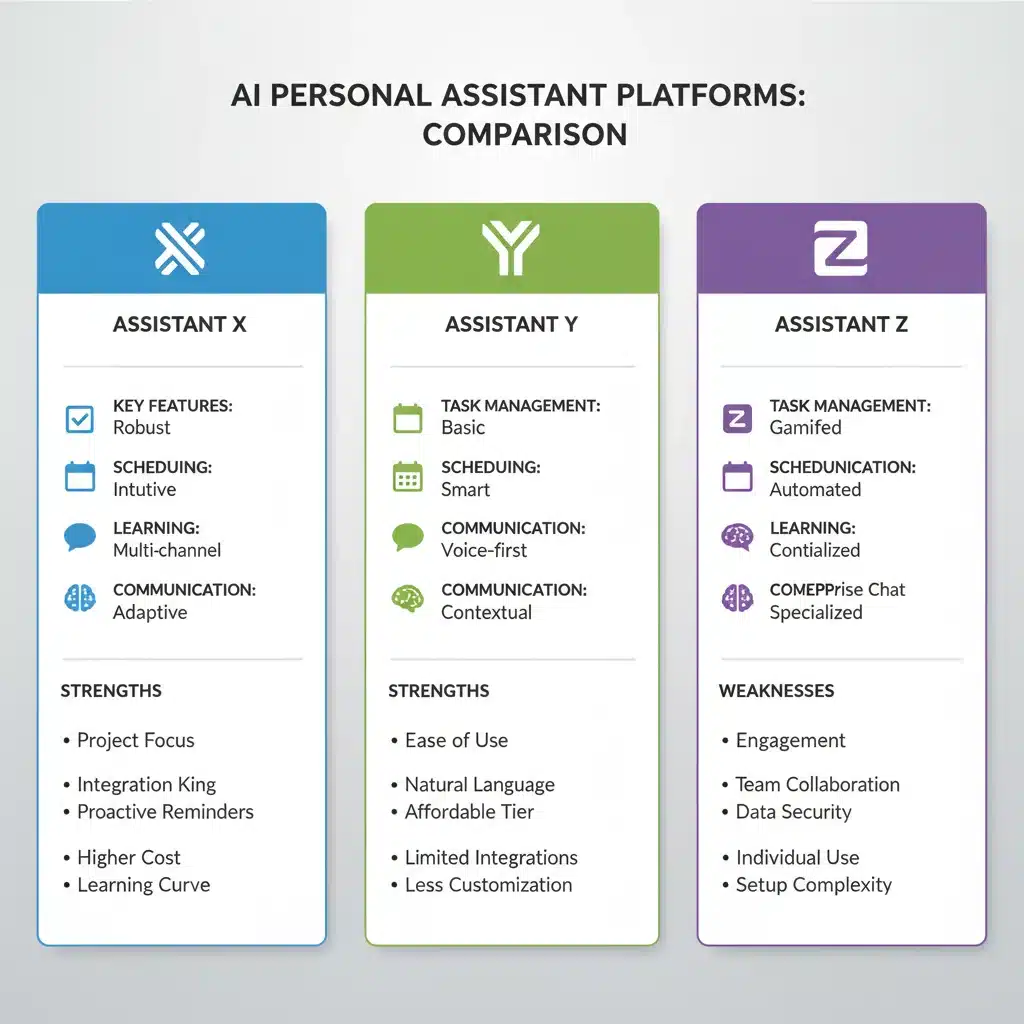
As we approach 2026, the landscape of AI personal assistants is more competitive and innovative than ever. While many platforms exist, three are poised to stand out due to their advanced features, robust ecosystems, and continuous development. Let’s delve into these top contenders, examining their unique offerings and how they are set to revolutionize daily efficiency.
1. "Cognito AI" (Hypothetical Platform)
Overview: Cognito AI represents the pinnacle of proactive, context-aware assistance. It’s designed not just to respond to commands but to anticipate user needs, often before they are explicitly articulated. Built on a foundation of proprietary deep learning models, Cognito AI excels in understanding complex human intentions and predicting future actions based on historical data and real-time environmental factors.
Key Features & Strengths:
- Hyper-Personalization: Cognito AI creates a deeply personalized user profile, learning individual habits, preferences, and even emotional states to tailor its assistance. This means suggestions for breaks, optimal work times, and even mood-boosting activities are genuinely relevant.
- Predictive Analytics & Proactive Solutions: Beyond reminders, Cognito AI actively offers solutions. For instance, if it detects a pattern of late-night work, it might suggest adjusting your schedule or blocking out "no-work" hours. If it notices a flight delay, it proactively rebooks meetings and informs relevant parties.
- Seamless Cross-Platform Integration: Its strength lies in its ability to seamlessly integrate with virtually every digital service imaginable – from enterprise software to smart home devices, health trackers, and personal finance apps. This creates a truly unified digital ecosystem.
- Advanced Natural Language Understanding: Cognito AI boasts industry-leading NLP, capable of understanding nuanced language, sarcasm, and complex multi-part questions, making interactions feel incredibly natural and intuitive.
- Ethical AI & Privacy Focus: A significant emphasis is placed on user data privacy and ethical AI development, offering robust encryption and transparent data usage policies, giving users greater control over their information.
Areas for Improvement: Given its advanced capabilities, Cognito AI might have a steeper learning curve for new users, and its premium subscription could be a barrier for some. The sheer volume of features might also be overwhelming initially.
Impact on Daily Efficiency: Cognito AI promises to virtually eliminate digital friction. By proactively managing schedules, tasks, and information flow, it frees up significant cognitive load, allowing users to focus on creative and strategic thinking. Its predictive capabilities ensure that potential issues are addressed before they become problems, leading to unparalleled levels of efficiency and reduced stress.
2. "Nexus Assistant" (Hypothetical Platform)
Overview: Nexus Assistant is designed as the ultimate productivity hub, particularly for professionals and teams. While it offers robust personal assistance, its core strength lies in optimizing collaborative workflows, streamlining communication, and providing actionable insights for project management. It’s built for those who operate in complex, interconnected work environments.
Key Features & Strengths:
- Team Collaboration & Project Management: Nexus Assistant integrates deeply with team communication tools (e.g., Slack, Microsoft Teams), project management software (e.g., Jira, Asana), and CRM systems. It can summarize team discussions, assign tasks, track progress, and generate collaborative reports.
- Meeting Optimization: From scheduling to minute-taking and action item distribution, Nexus Assistant automates the entire meeting lifecycle. It can even analyze meeting transcripts to identify key decisions and follow-up tasks.
- Information Centralization & Search: It acts as a powerful knowledge base, indexing information across all your connected work applications. Users can ask complex queries and receive consolidated answers, pulling data from emails, documents, and internal wikis.
- Cross-Device & Multi-Modal Experience: Nexus Assistant offers a consistent experience across desktops, mobile devices, and even smart displays, supporting voice, text, and gesture inputs.
- Customizable Workflows: Users and administrators can define custom automation workflows, allowing the assistant to handle specific, repetitive business processes tailored to their organization’s needs.
Areas for Improvement: While strong in professional settings, Nexus Assistant might be overkill for purely personal use cases. Its extensive integration capabilities could also pose initial setup challenges for less tech-savvy users.
Impact on Daily Efficiency: Nexus Assistant transforms group productivity. By automating administrative tasks, centralizing information, and optimizing communication, it significantly reduces overhead in collaborative projects. This leads to faster project completion, fewer communication breakdowns, and a more focused, efficient team. For individuals, it ensures that their contributions are always aligned with team goals and that they are always aware of critical updates.
3. "AuraMind AI" (Hypothetical Platform)
Overview: AuraMind AI is positioned as the holistic well-being and lifestyle enhancer. While it handles traditional efficiency tasks, its unique selling proposition is its focus on integrating personal productivity with mental and physical wellness. It aims to create a balanced and sustainable approach to daily efficiency, recognizing that true productivity stems from overall well-being.
Key Features & Strengths:
- Wellness Integration: AuraMind AI connects with health trackers, meditation apps, and smart home devices to monitor sleep patterns, activity levels, and stress indicators. It can then suggest personalized breaks, mindfulness exercises, or even adjust lighting and temperature to optimize your environment.
- Learning & Skill Development: Beyond task management, AuraMind AI acts as a personal learning coach. It identifies skill gaps, suggests relevant online courses or articles, schedules dedicated learning time, and tracks progress towards personal development goals.
- Personal Finance Management: It offers robust integration with banking and budgeting apps, providing insights into spending habits, suggesting savings strategies, and even automating bill payments, all while maintaining strict security protocols.
- Creative Augmentation: For creative professionals, AuraMind AI can assist with brainstorming, generating ideas based on user inputs, organizing research, and even suggesting stylistic improvements in writing or design projects.
- Adaptive User Interface: The interface of AuraMind AI is highly adaptive, changing its layout and suggestions based on the time of day, your current activity, and even your detected mood, providing a truly intuitive experience.
Areas for Improvement: The breadth of its features might mean that some core productivity functions are not as deeply specialized as in platforms like Nexus Assistant. Its wellness focus might also not appeal to users solely interested in task automation.
Impact on Daily Efficiency: AuraMind AI redefines efficiency by linking it to overall well-being. By ensuring users are rested, focused, and continuously developing, it fosters a sustainable model of productivity. Reduced burnout, improved mental clarity, and a stronger sense of purpose lead to higher quality output and a more fulfilling daily routine. It helps users not just do more, but do better, with a focus on long-term sustainability.
Each of these hypothetical platforms represents a distinct approach to leveraging AI personal assistants for daily efficiency. While Cognito AI prioritizes proactive anticipation, Nexus Assistant focuses on collaborative productivity, and AuraMind AI champions holistic well-being. The choice among them will largely depend on individual priorities and the specific areas where users seek the most significant impact on their efficiency by 2026.
The Broader Impact on Daily Life and Work by 2026
The proliferation and advancement of AI personal assistants by 2026 will extend far beyond mere task automation, fundamentally reshaping our daily lives and the very nature of work. This transformative impact will be felt across various domains, leading to a paradigm shift in how we interact with technology and manage our personal and professional responsibilities.
Reclaiming Time and Reducing Cognitive Load
Perhaps the most significant impact will be the reclamation of personal time and a substantial reduction in cognitive load. Imagine the hours saved when an AI assistant handles all your scheduling, email triage, information gathering, and even basic communication. This frees up mental bandwidth that was previously consumed by administrative overhead, allowing individuals to dedicate more energy to creative pursuits, strategic thinking, problem-solving, or simply enjoying leisure activities. The cumulative effect of these small efficiencies will translate into significantly more free time and a less stressful existence.
Enhanced Decision-Making and Personalized Learning
AI personal assistants will become invaluable aids in decision-making. By synthesizing vast amounts of data and presenting relevant insights, they will empower users to make more informed choices, whether it’s about financial investments, career paths, or even daily purchases. Furthermore, the personalized learning capabilities of these assistants will foster continuous skill development. They will identify knowledge gaps, recommend tailored learning resources, and schedule study times, effectively acting as lifelong digital mentors. This constant learning loop will ensure individuals remain agile and competitive in a rapidly evolving world.
Transforming the Workplace: From Automation to Augmentation
In the professional realm, AI personal assistants will shift the focus from automation to augmentation. Repetitive, rule-based tasks will be almost entirely handled by AI, allowing human workers to concentrate on tasks requiring creativity, critical thinking, emotional intelligence, and complex problem-solving. This will lead to a more fulfilling work experience, as employees are engaged in higher-value activities. Teams will become more efficient, collaboration will be streamlined, and businesses will gain a competitive edge through optimized operations and quicker decision cycles. The traditional 9-to-5 workday might even evolve as AI enables more flexible and output-focused work models.
Improved Work-Life Balance and Well-being
The holistic approach of some AI assistants, like the hypothetical AuraMind AI, highlights a growing trend: the integration of productivity with well-being. By 2026, AI will be instrumental in helping individuals achieve a better work-life balance. Assistants will monitor stress levels, suggest timely breaks, encourage physical activity, and even help manage personal commitments to prevent burnout. This emphasis on well-being recognizes that a healthy individual is a more productive individual, leading to a more sustainable and enjoyable lifestyle.
Ethical Considerations and the Human-AI Partnership
As AI personal assistants become more powerful and pervasive, ethical considerations will be paramount. Discussions around data privacy, algorithmic bias, and the potential for over-reliance on AI will intensify. By 2026, it is expected that robust regulatory frameworks and industry best practices will be in place to address these concerns, ensuring that AI development remains human-centric and beneficial. The future will be defined by a synergistic partnership between humans and AI, where technology serves to augment human capabilities rather than replace them, creating a world where efficiency, innovation, and well-being coexist.

Challenges and Future Outlook of AI Personal Assistants
While the trajectory for AI personal assistants is overwhelmingly positive, the path to 2026 and beyond is not without its challenges. Addressing these hurdles will be crucial for the continued success and widespread adoption of these transformative technologies. Understanding the potential obstacles and the future outlook provides a balanced perspective on their evolving role.
Data Privacy and Security Concerns
As AI personal assistants become deeply integrated into our lives, handling sensitive personal and professional data, privacy and security will remain paramount concerns. The more an assistant knows about us – our schedules, finances, health, and communications – the greater the risk if that data is compromised. Developers must continuously invest in state-of-the-art encryption, robust cybersecurity measures, and transparent data handling policies. Users, in turn, will need to be educated on how their data is used and have clear control over their privacy settings. Building and maintaining trust will be fundamental for widespread adoption.
Algorithmic Bias and Fairness
AI systems learn from the data they are fed, and if that data contains biases (often reflecting societal biases), the AI can perpetuate or even amplify them. Ensuring fairness and preventing algorithmic bias in AI personal assistants is a complex but essential challenge. This requires diverse training datasets, rigorous testing, and continuous auditing of AI models to ensure that recommendations, decisions, and interactions are equitable and unbiased across all user demographics. The goal is to create assistants that serve everyone fairly and effectively.
Interoperability and Ecosystem Fragmentation
Currently, the AI assistant landscape can be somewhat fragmented, with different platforms excelling in different areas and sometimes struggling to communicate seamlessly. While progress has been made, true interoperability – where an assistant can effortlessly manage tasks across various devices, operating systems, and third-party applications without friction – remains a challenge. By 2026, we anticipate greater standardization and open APIs that will allow for more fluid integration, creating a truly unified digital experience regardless of the underlying hardware or software.
User Adoption and Digital Literacy
For all their sophistication, AI personal assistants are only as effective as their users’ ability to leverage them. A significant challenge lies in ensuring broad user adoption across different age groups and technical proficiencies. This requires intuitive interfaces, comprehensive onboarding processes, and ongoing education to help users understand the full capabilities of their assistants. Bridging the digital literacy gap will be crucial to unlock the full potential of AI for daily efficiency for a wider population.
The "Black Box" Problem and Explainable AI
Many advanced AI models operate as "black boxes," meaning their decision-making processes are opaque and difficult for humans to understand. For AI personal assistants, this can lead to a lack of trust if users don’t understand why a particular recommendation or action was taken. The development of Explainable AI (XAI) will be critical, allowing assistants to articulate the reasoning behind their suggestions, thereby fostering greater transparency and user confidence. This will be particularly important in sensitive areas like financial advice or health recommendations.
Future Outlook: Beyond 2026
Looking beyond 2026, AI personal assistants are poised to become even more integrated and intelligent. We can expect advancements in:
- True "Ambient Intelligence": AI assistants seamlessly operating in the background, anticipating needs across smart environments (home, car, office) without explicit commands.
- Empathy and Emotional Intelligence: Assistants that can not only detect but also genuinely understand and respond to human emotions, offering more empathetic and supportive interactions.
- Proactive Learning and Adaptation: AI that continuously learns and adapts to subtle changes in user behavior, preferences, and external circumstances, becoming even more predictive and personalized.
- Specialized AI Assistants: A rise in highly specialized AI assistants tailored for niche professions (e.g., medical AI assistants, legal AI assistants) or specific personal needs (e.g., elderly care AI assistants).
The future of AI personal assistants is one of continuous innovation and deeper integration into the fabric of our lives. By proactively addressing challenges and embracing ethical development, these digital companions will continue to redefine daily efficiency, making our lives more productive, balanced, and enriched.
Conclusion: Embracing the Future of Efficiency with AI Personal Assistants
The journey through the evolving landscape of AI personal assistants paints a vivid picture of a future where daily efficiency is not just an aspiration but an attainable reality. As we stand on the cusp of 2026, these intelligent digital companions are no longer confined to the realm of science fiction; they are sophisticated, indispensable tools poised to revolutionize every facet of our personal and professional lives. From their humble beginnings as simple command-response systems, AI personal assistants have matured into cognitive partners, capable of understanding context, anticipating needs, and proactively optimizing our routines with remarkable precision.
Our deep dive into the core pillars of efficiency – intelligent task management, seamless scheduling, information synthesis, proactive reminders, and streamlined communication – underscores the multifaceted ways in which these platforms contribute to a more productive existence. They are designed to offload the mundane, filter the noise, and empower us to focus on high-value activities that demand our unique human capabilities. The time saved and the cognitive load reduced by these assistants are not just marginal gains; they represent a significant liberation of mental and temporal resources.
The comparison of hypothetical leading platforms like Cognito AI, Nexus Assistant, and AuraMind AI illustrates the diverse approaches to achieving this efficiency. Whether it’s through hyper-personalization and predictive analytics, robust team collaboration and project management, or a holistic integration of productivity with well-being, each platform offers a unique pathway to a more optimized life. The choice among them will increasingly depend on individual needs, professional demands, and personal values, allowing users to select the AI companion that best resonates with their desired lifestyle.
Beyond individual productivity, the broader impact of AI personal assistants by 2026 is set to transform the very nature of work and daily living. They promise to foster better work-life balance, enhance decision-making through data-driven insights, and promote continuous learning and skill development. The workplace will evolve into an environment where human creativity and critical thinking are augmented by AI, leading to more fulfilling roles and innovative outcomes. This synergistic partnership between humans and AI will redefine what it means to be productive, pushing the boundaries of what we thought was possible.
However, the path forward is not without its challenges. Addressing concerns around data privacy, algorithmic bias, interoperability, and user adoption will be crucial. The commitment to ethical AI development, transparent practices, and continuous innovation will ensure that these powerful tools serve humanity’s best interests. As we move beyond 2026, we can anticipate further advancements in ambient intelligence, emotional understanding, and specialized AI, leading to an even more seamless and intuitive integration of AI into every aspect of our existence.
In conclusion, embracing the future of efficiency means embracing the power of AI personal assistants. They are not just technological marvels but catalysts for a more organized, less stressful, and ultimately more fulfilling life. By thoughtfully integrating these platforms into our routines, we can unlock unprecedented levels of productivity and reclaim our most precious asset: time. The era of the intelligent digital companion is here, and it’s poised to make 2026 a landmark year for personal efficiency.