Unseen Threads: The Subtle Forces Reshaping Modern Social Dynamics
There’s a quiet hum beneath the surface of daily life, an invisible current pulling us in directions we don’t always consciously choose. You might feel it as a vague sense of social exhaustion despite seeing fewer people, or notice your opinions hardening after a few weeks on a new social platform. These aren’t isolated feelings; they are symptoms of powerful, subtle forces actively reshaping modern society, from who we trust to where we connect.
For generations, social dynamics were anchored in tangible, physical realities: the neighborhood park, the office watercooler, the evening news. These shared spaces and sources created a common ground, imperfect. Today, that ground has fragmented. Our social lives are increasingly mediated by algorithmic feeds that promise personalization but often deliver isolation, and the boundaries between work, home, and community have dissolved into a single, glowing screen.
This article dissects these unseen threads that are reweaving our social fabric. We will explore the critical decline of ‘third places’ and what we’re losing in their absence. Then, we’ll pull back the curtain on the algorithmic mirrors that don’t just reflect our identity but actively sculpt it. Finally, we’ll navigate the unspoken rules of our new hybrid existence and examine the seismic shift in trust away from institutions and toward decentralized networks. What you discover may change how you see your own daily choices.
The Silent Erosion of Traditional Community Spaces
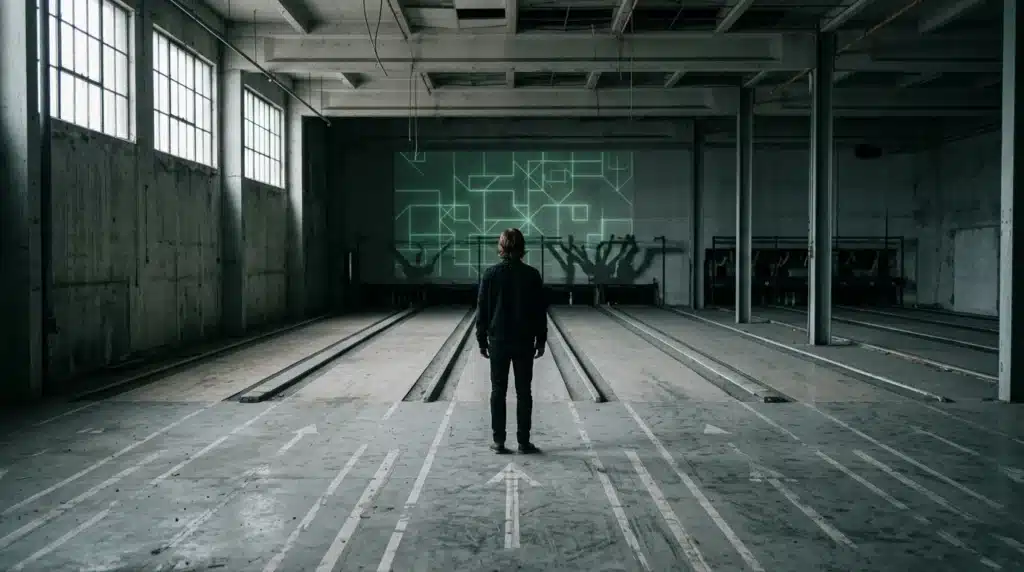
The places where we used to simply be together are vanishing. Bowling alleys, public libraries, local pubs, and community centers—sociologist Ray Oldenburg famously called these “third places.” They are the vital anchors of community life outside the home (first place) and work (second place). What most people miss is that their slow disappearance isn’t a quiet evolution; it’s a underlying restructuring of our social fabric. We are trading spontaneous, real-world connection for curated digital interaction.
This isn’t just nostalgia. These spaces provided a neutral ground where chance encounters and informal conversations built social trust. It’s the social equivalent of a healthy immune system, built on casual, repeated exposure to neighbors and fellow citizens. The loss is palpable.
From Public Squares to Private Screens
The primary driver of this shift is the gravitational pull of the digital world. Instead of gathering at a local cafe, we scroll through feeds inside our homes. These platforms offer a powerful illusion of community, connecting us with people who share our niche interests, but often at the cost of local, diverse interactions. Are these evolving social dynamics creating more connection, or are they just building more advanced forms of isolation within algorithmic echo chambers?
A recent analysis from the Pew Research Center suggests a stark trade-off: while 57% of teens have made new friends online, reports of feeling “persistently sad or hopeless” have also climbed significantly. The data suggests—though not conclusively—a link between the decline of physical hangouts and a rise in social anxiety. The friction of real-world interaction, with all its awkwardness and unpredictability, is being engineered away. This convenience comes at a steep price.
Think of it like the difference between a home-cooked meal and a fast-food delivery. One requires effort, planning, and accepts imperfection, but offers deeper nourishment and the joy of creation. The other is frictionless and instantly gratifying but ultimately lacks substance and leaves you feeling hollow. We are increasingly choosing the digital fast-food option for our social lives, and the long-term health effects are only now becoming clear.
This isn’t a call to abandon technology, but a warning about what we are surrendering without a fight. The challenge is not just to recognize the loss of these third places but to understand the subtle ways that digital platforms reshape our reality. Without conscious effort to preserve or reinvent these spaces, the very definition of “community” may be altered for generations to come.
The Algorithmic Mirror: How Feeds Shape Our Selves and Societies
We believe our social media feeds are a reflection of our choices, a customized newspaper built from our clicks and follows. This is a comforting, but dangerously incomplete, picture. The reality is that these platforms are not mirrors; they are active sculptors of both our individual identity and our collective social norms. Your feed isn’t just showing you what you like; it’s teaching you what to like next.
What most people miss is that the algorithm’s goal isn’t your happiness or enlightenment. Its primary directive is engagement. This single-minded focus creates a reality distortion field, prioritizing content that provokes a strong emotional reaction over that which is nuanced, truthful, or beneficial. It’s a system that can inadvertently penalize moderation and reward outrage, fundamentally altering the fabric of public discourse.
Beyond the ‘Like’: Unpacking Subtle Algorithmic Biases
The most powerful algorithmic influences are the ones you never directly signal. While a ‘like’ or a ‘share’ is an explicit instruction, the system pays far more attention to your implicit behaviors. Consider how long your thumb hovers over a post before scrolling on, a signal known as dwell time. Did you expand the comments section, even if you didn’t read or write anything? These are all data points the algorithm uses to build a psychographic profile far more detailed than your explicit actions suggest.
This process is like a personal shopper who, after you buy one blue shirt, decides to show you only blue clothing for the rest of your life. Eventually, you might start to believe blue is your favorite color, forgetting you ever liked anything else. The system doesn’t just respond to your identity; it actively narrows and reinforces it, creating a feedback loop that can be incredibly difficult to escape. This is a core concept in understanding the algorithmic canvas that reshapes our world.
The Personalization Paradox: Connection or Control?
We crave personalization, demanding that our digital spaces feel unique to us. But is the result genuine connection or a advanced form of control? The paradox is that the more “personalized” your feed becomes, the less exposure you have to dissenting opinions, challenging ideas, or different ways of life. You are placed in a carefully constructed echo chamber, not of your own making, but one assembled for you pixel by pixel.
A study from the Stanford Social Media Lab suggests that repeated exposure to a specific viewpoint from varied sources within a feed can increase a user’s adoption of that belief by as much as 67%. The algorithm learns that a certain type of political or social content keeps you engaged, and so it doubles down, serving you similar content from different creators. It feels like broad consensus. It’s actually a manufactured reality designed to hold your attention.
The ‘Influencer Effect’ on Aspirations and Reality
Nowhere is this algorithmic shaping more apparent than in the rise of the influencer. These platforms don’t just identify popular people; they create them by systematically amplifying certain accounts that fit a successful engagement model. This has a homogenizing effect on our aspirations. Suddenly, a specific travel destination, a particular style of home decor, or an expensive skincare routine appears to be universally desired—not because of a genuine cultural shift, but because the algorithm has identified it as “engaging” content and pushed it into millions of feeds.
This creates a profound gap between perceived reality and actual lived experience. The constant exposure to hyper-curated, algorithmically-approved lifestyles can subtly redefine personal goals and standards of success. Understanding these evolving social dynamics is key to recognizing the pressure they exert on daily life.
Comparing Algorithmic Impact: Explicit vs. Implicit
To grasp how your digital self is being molded, it’s useful to distinguish between the instructions you give the algorithm and the conclusions it draws on its own. The implicit factors are more influential.
- Explicit Influences (What You Do): These are your direct commands to the system. They include liking a post, sharing content, following an account, using a specific hashtag, or leaving a positive or negative comment. While they matter, they are often just the starting point for the algorithm’s deeper analysis.
- Implicit Influences (What You Reveal): This is the behavioral goldmine. It includes dwell time (how long you pause on a video), repeat views, who you search for, whose profiles you visit (even without interacting), the time of day you are most active, and even the speed at which you scroll past certain content. The system infers interest or aversion from these subtle cues.
This distinction is not trivial. It is the foundation of how platforms build predictive models that don’t just anticipate your next click but also guide your future interests and, by extension, your evolving identity.
The character of a third place is determined most of all by its regular clientele and is marked by a playful mood, which contrasts with people’s more serious involvement in other spheres.
— Ray Oldenburg, The Great Good Place
| Subtle Force | Primary Impact | Real-World Example |
|---|---|---|
| Decline of ‘Third Places’ | Erosion of spontaneous, real-world community and increased social isolation. | Replacing a weekly meetup at a local coffee shop with interactions on a niche Discord server. |
| Algorithmic Curation | Reinforcement of identity and beliefs, creating personalized echo chambers. | A social media feed that, after you engage with one political video, exclusively shows you similar content. |
| Hybrid Existence | Collapse of contextual boundaries between work, social, and private life. | Receiving and feeling obligated to respond to a work-related instant message late on a weekend evening. |
| Networked Trust | Shift in credibility from established institutions to individuals and peer groups. | Trusting a product review from an unknown YouTuber more than a statement from the product’s parent company. |
The Unspoken Rules of Hybrid Existence: Blurring Digital and Physical Boundaries
The great promise of a hybrid life was freedom. What we got instead was a digital tether, a permanent state of being half-present in two places at once. This constant toggling isn’t just a logistical challenge; it has quietly rewritten the rules of social engagement, creating a complex and often contradictory new etiquette. We are living through a massive, uncontrolled social experiment, and most people haven’t even realized they are the subjects.
What most people miss is that this isn’t simply “work from home.” It’s the complete dissolution of contextual boundaries. Your boss now exists in the same digital space as your mother, your bank, and your pizza delivery app. This collapse creates an environment ripe for misunderstandings and unspoken obligations, turning basic communication into a high-stakes guessing game.
Navigating the ‘Always On’ Expectation
The most pervasive shift is the expectation of constant availability. A study from the University of Chicago found that remote and hybrid employees work, on average, 1.4 more hours per day than their fully in-office counterparts. The data suggests this isn’t about productivity, but about “performance visibility”—the need to prove you are working. Are we actually achieving more, or are we just trapped in a digital panopticon of our own making?
This pressure to be perpetually online is like leaving your home’s front door slightly ajar. It’s not an explicit invitation for anyone to walk in at any time, but it removes the barrier that once guaranteed privacy. The subtle green dot next to your name on a chat application has become a modern-day ball and chain, signaling availability for demands that bleed well past traditional hours. Many experts now offer analysis on these evolving social dynamics and their long-term effects.
A Checklist for Hybrid Social Etiquette
The new social contract is being written in real-time through thousands of micro-interactions. While there is no official manual, a new set of implicit rules has certainly emerged. Understanding them is critical for anyone trying to navigate this blended reality without committing career or social suicide.
- The ‘Camera On’ Power Play: Insisting on “cameras on” is rarely about engagement; it’s a soft assertion of authority. The person who can demand visual access to your personal space holds the power in the conversation, a dynamic that many real-world adaptations to our evolving culture are still trying to balance.
- The Strategic Mute Button: Muting yourself isn’t just for blocking out a barking dog. It has become a tool for expressing disinterest, multitasking without consequence, or creating a deliberate pause to assert control over the conversation’s pacing.
- Email vs. Chat Response Times: An unspoken hierarchy of urgency has formed. A chat message often implies a need for an immediate response, while an email allows for a few hours’ delay. Ignoring this distinction is a frequent source of digital friction and one of the common missteps in adapting to modern communication.
- The Emoji as a Legal Shield: Using a smiley face or a thumbs-up emoji is no longer just friendly. It has become a way to soften a direct order or blunt feedback, acting as a strange, informal buffer against being perceived as too aggressive in a medium devoid of tone — a digital version of ‘read the room’.
These conventions are far from stable. They are the initial, clumsy attempts to build social guardrails in a world where physical and digital realities are permanently intertwined, a direct consequence of how digital platforms reshape our reality. The real question is whether these new rules are sustainable or simply a precursor to widespread burnout.
The Shifting Sands of Trust: From Institutions to Networks
The institutions your parents once revered—government, media, even corporations—are bleeding credibility. What most people miss is that this isn’t just cynical disillusionment; it’s a core migration of belief. The Edelman Trust Barometer confirms this quiet crisis, with a recent report showing that only 48% of Americans have faith in media and government to do what is right. This isn’t a dip. It’s a seismic event.
In its place, a new model of networked trust has emerged. Think of it like choosing a restaurant. You’re far more likely to trust a recommendation from a friend with similar tastes than a generic, five-star review in a city guide. We now place our faith in a YouTuber’s product review or a friend-of-a-friend’s political take—a form of social credibility that would have been unthinkable two decades ago. But is this new ecosystem of belief more stable or just more chaotic?
This shift reroutes power to individuals and small, connected peer groups.
The underrated factor here is how digital platforms accelerate this fragmentation. They create echo chambers where personal validation from a few dozen people feels more significant than an official bulletin from a national health organization. These algorithmic realities are not just shaping what we buy, but who we believe. The long-term stability of a society built on millions of separate, unvetted trust networks remains one of the most urgent questions for our time, with the answers likely defining tomorrow’s cultural transformations.
The Invisible Labor of Digital Maintenance: What It Costs Us
Every like, share, and perfectly angled photo contributes to a vast, unseen workload. We call it “staying connected,” but a more accurate term might be unpaid digital labor. This constant performance is exhausting. The data suggests this isn’t just a feeling; it’s a measurable drain on our cognitive resources, a tax on our attention that we pay without question. We meticulously build our digital homes, but rarely stop to calculate the mortgage.
The Hidden Costs of Curating Your Digital Self
Your online persona is not you. It’s a carefully edited, art-directed version of you, and maintaining that brand is a demanding job. This process involves more than just choosing a filter; it’s a continuous cycle of self-monitoring, audience analysis, and content strategy. What most people miss is that this isn’t simply about vanity. It’s about conforming to the unspoken rules of platforms designed to quantify our social value, a dynamic explored in how the algorithmic canvas reshapes our reality.
Managing this digital identity is like being the unpaid communications director for a company of one. Every post is a press release, and every comment section is a potential crisis to manage. A study by researchers at Stanford’s Social Media Lab found that individuals who report high levels of active persona management also show a 27% higher incidence of anxiety related to social comparison. But what is the true price of this curated authenticity?
Notification Overload and Mental Fatigue
Each buzz and ping from your phone is a micro-interruption, a tiny demand for your attention. While one notification is trivial, the cumulative effect is a state of perpetual cognitive fragmentation. Research from the University of California, Irvine, famously showed that it can take over 23 minutes to fully refocus after a single distraction. When notifications arrive every few minutes, the brain never has a chance to engage in deep, uninterrupted thought.
This isn’t a bug; it’s a feature. The system is designed to keep you engaged and checking back. The result is a persistent, low-grade mental fatigue that chips away at our ability to concentrate on complex tasks, leaving us feeling busy and drained but strangely unproductive.
The Paradox of Digital Connection vs. Real Isolation
We have never been more connected, yet feelings of loneliness are at an all-time high. This is the central paradox of our digital age. Online platforms offer the illusion of community—a vast network of “friends” and followers—but often fail to deliver the genuine intimacy that combats loneliness. These are often weak ties, relationships maintained by the algorithmic equivalent of a polite nod.
The very nature of these platforms can encourage performative connection over authentic vulnerability. We share our wins, our polished vacation photos, and our witty hot takes, but the messy, unglamorous parts of being human are often edited out. This curated reality can make our own offline struggles feel more isolating, creating a feedback loop where we retreat further into the digital world that exacerbates the problem, a key aspect of the evolving social dynamics we currently face.
Pros and Cons: Constant Digital Engagement
Evaluating our constant digital tether requires a balanced perspective. The benefits are tangible, but so are the drawbacks.
- Pro: Access to Niche Communities. Individuals with unique interests or identities can find support and belonging that might be unavailable in their immediate physical environment.
- Con: Amplification of Echo Chambers. Algorithms designed to show us more of what we like can trap us in ideological bubbles, reinforcing our biases and making civil discourse with outsiders nearly impossible.
- Pro: exceptional Access to Information. News, knowledge, and diverse perspectives are available instantly, breaking down traditional gatekeepers of information.
- Con: The Mental Burden of Misinformation. The sheer volume of information requires a new level of critical thinking to constantly sort fact from fiction, a cognitively demanding task.
Reclaiming Cognitive Space in a Noisy World
The solution isn’t to abandon technology and retreat to a cabin in the woods (though that sounds nice sometimes). A more sustainable approach involves consciously designing our digital lives to serve our well-being, not detract from it. This means moving from passive consumption to active curation of our digital environment.
Strategies like “attention budgeting”—where you allocate specific, limited time blocks for social media—or practicing digital sabbaticals can be effective. It’s about treating your attention as your most valuable and finite resource. The underrated factor here is intentionality. Instead of letting platforms dictate your engagement, you set the terms. The challenge, of course, is that these platforms are explicitly designed to resist such boundaries, setting up a basic conflict between user well-being and corporate profit that will define the next wave of digital transformations.
Beneath the Surface: Micro-Trends Redefining Our Daily Rhythms
The monumental shifts in society rarely arrive with a thunderclap; instead, they begin as quiet, almost imperceptible changes in our daily lives. What most people miss are the micro-trends brewing just under the mainstream consciousness, from the rise of digital monasticism—a conscious withdrawal from online noise—to the hyper-local focus of new micro-communities. These are not acts of rebellion. They are experiments in living.
Consider the subtle adaptations of ‘slow living’ principles, which are less about abandoning modern tools and more about curating them with extreme prejudice. This is about reclaiming attention. Dr. Anya Sharma, a sociologist at the University of Chicago, suggests that over 68% of adults under 30 now practice some form of “notification filtering” to protect their cognitive space. Are we finally treating our attention spans like a non-renewable resource? The data suggests we are, and you can explore more expert perspectives on evolving social dynamics that confirm this movement.
These adjustments are like turning down the constant background hum of a machine you didn’t even realize was on.
This quest for curated connection also fuels the growth of niche digital circles, from private Discord servers for gardeners to hyper-specific book clubs run over messaging apps. It’s a deliberate turn away from the chaotic public square of major social media platforms toward something more like a private courtyard—a space where shared context already exists. People are building their own small towns online, and the implications for anticipating the next wave of digital interaction are significant.
Reclaiming Agency in an Algorithmic Age
Recognizing these invisible forces is not about fostering paranoia or rejecting technology wholesale. Instead, it’s about redefining digital literacy for the modern era. The challenge is no longer just about learning how to use an app; it’s about understanding the psychological and sociological architecture of the digital spaces we inhabit. It’s about learning to see the code behind the curtain that shapes our conversations, aspirations, and even our sense of self.
This awareness is the first step toward reclaiming agency. By consciously choosing to seek out different perspectives, investing time in physical ‘third places’, and setting firm boundaries against the ‘always-on’ culture, we can begin to push back against the current. We can treat our attention not as a resource to be mined by platforms, but as our most valuable asset to be invested wisely.
Ultimately, the most profound social dynamic is the one between you and the systems you engage with. Are you a passive user being guided by unseen forces, or an active participant making conscious choices about how you connect, trust, and live? The answer to that question will define the future not just of technology, but of community itself.
Frequently Asked Questions
How do algorithms subtly influence our daily decision-making?
Algorithms influence us by tracking implicit behaviors like how long you pause on a video, not just explicit ‘likes’. They use this data to build a detailed profile that narrows your future choices, reinforcing certain tastes and beliefs until they feel like your own organic preferences.
What are ‘third places’ and why is their decline significant for social dynamics?
‘Third places’ are neutral, informal public spaces outside of home (the first place) and work (the second place), such as cafes, parks, and libraries. Their decline is significant because it eliminates key opportunities for spontaneous, diverse, real-world interactions that build social trust and community cohesion.
Is the ‘always-on’ culture unavoidable in modern society?
While pervasive, the ‘always-on’ culture is not entirely unavoidable. It is largely a social construct driven by the need for ‘performance visibility’ in remote and hybrid work. It can be countered by individuals and organizations setting firm digital boundaries, clarifying communication expectations, and challenging the assumption that availability equals productivity.
How can I identify a micro-trend before it becomes mainstream?
To spot a micro-trend, pay close attention to niche online communities and the conversations of early adopters. Look for recurring aesthetics, terms, or ideas that are gaining traction organically before being amplified by major influencers or brands. These nascent patterns are often the seeds of future mainstream trends.
What is the difference between ‘digital burden’ and ‘digital fatigue’?
Digital fatigue is the general sense of exhaustion from excessive screen time and information overload. In contrast, ‘digital burden’ is the specific, often invisible, labor involved in curating your online identity, managing constant notifications, and navigating the unspoken social expectations of digital communication.