Decoding 2026 Social Movements: Insider Strategies for Deep Understanding
In an increasingly interconnected yet fractured world, understanding the dynamics of 2026 social movements is not merely an academic exercise; it’s a critical skill for policymakers, businesses, activists, and engaged citizens alike. The headlines often capture the visible eruptions of dissent, the dramatic protests, and the immediate demands. However, beneath this surface lies a complex tapestry of underlying grievances, emergent technologies, shifting demographics, and evolving ideologies that truly define the trajectory of social change. This article delves beyond the superficial, offering insider strategies and analytical frameworks to provide a profound understanding of what will drive and shape 2026 social movements.
We will explore how to identify the nascent signals of change, dissect the intricate web of causal factors, and anticipate the forms and impacts of future collective action. Our goal is to equip you with the tools to move beyond reactive observation to proactive comprehension, enabling you to navigate and engage with the social landscape of 2026 with informed insight.
The year 2026 is not an arbitrary point; it represents a near-future landscape where current trends will have matured, new technologies will be mainstream, and global challenges will have intensified. Therefore, our analysis must be forward-looking, yet grounded in the historical patterns of social mobilization.
The Shifting Sands: Macro Trends Shaping 2026 Social Movements
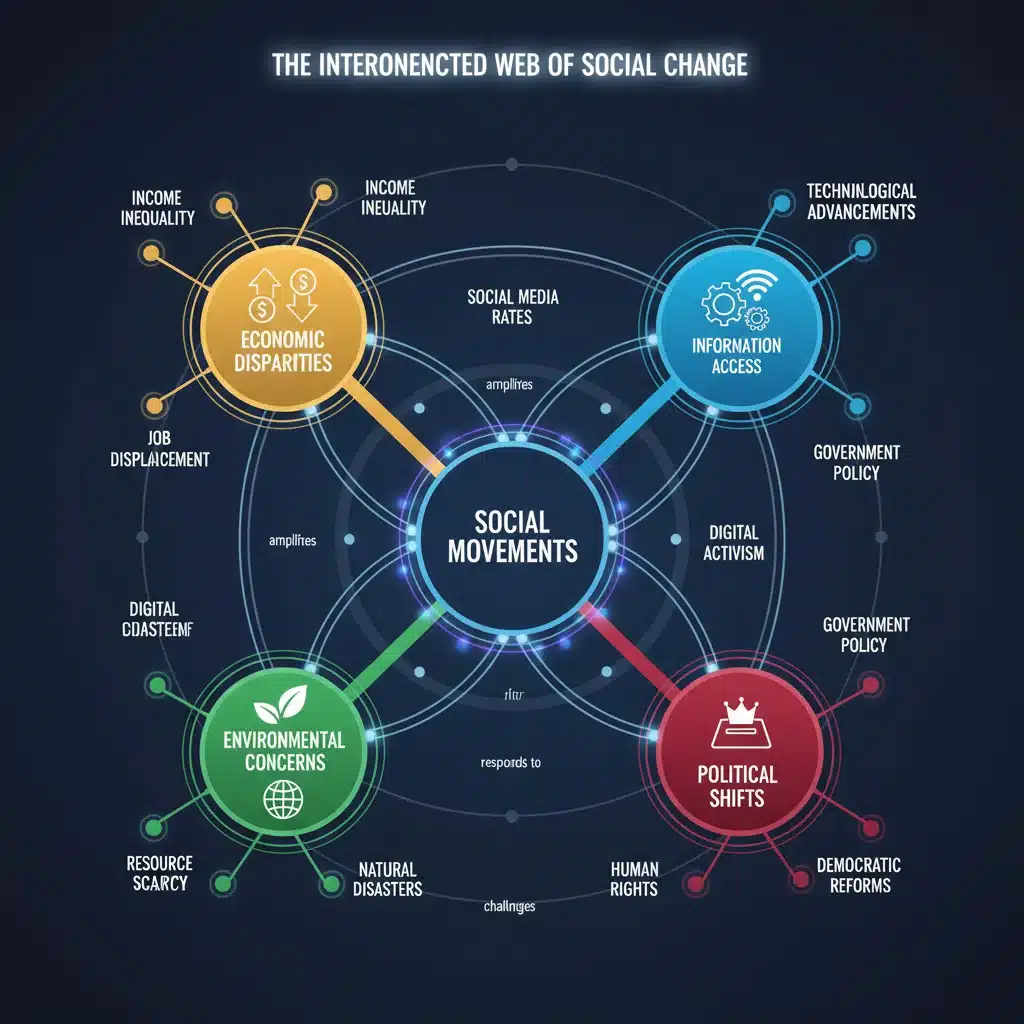
To truly grasp the essence of 2026 social movements, we must first analyze the overarching macro trends that are currently reshaping our world. These are the fundamental forces that create the conditions for collective action, often acting as catalysts or exacerbating existing tensions. Ignoring these foundational shifts is akin to trying to understand a wave without considering the ocean.
Economic Disparities and the Quest for Equity
One of the most persistent and potent drivers of social unrest globally remains economic inequality. As we approach 2026, the gap between the ultra-rich and the working class is projected to widen in many regions, fueled by automation, globalization, and often, regressive tax policies. This disparity isn’t just about income; it extends to access to healthcare, education, housing, and opportunities. Movements demanding wealth redistribution, universal basic income, fair wages, and equitable access to essential services are likely to gain further momentum. The discourse will move beyond simple calls for charity to systemic critiques of capitalism and demands for fundamental economic restructuring. Expect to see movements advocating for cooperative models, ethical consumption, and accountability from multinational corporations.
The Climate Crisis: An Existential Imperative
The urgency of the climate crisis will undoubtedly be a central theme for 2026 social movements. As the impacts of climate change become more undeniable and severe – from extreme weather events to resource scarcity and forced migration – environmental activism will intensify and diversify. We will see not only traditional protests against fossil fuel companies but also movements demanding climate justice for vulnerable communities, advocating for rapid transitions to renewable energy, and pushing for systemic changes in consumption and production. The intersection of climate change with issues of racial justice, indigenous rights, and global equity will become even more pronounced, leading to powerful, intersectional movements that challenge existing power structures.
Technological Acceleration and its Dual Impact
The rapid advancement of technology, particularly AI, automation, and ubiquitous digital connectivity, presents a double-edged sword for 2026 social movements. On one hand, these technologies offer unprecedented tools for organization, communication, and global mobilization. Encrypted messaging, decentralized social networks, and AI-powered data analysis can enable activists to connect, strategize, and amplify their messages more effectively than ever before. On the other hand, the same technologies can be used for surveillance, censorship, and the spread of misinformation, posing significant challenges to free speech and collective action. Movements will likely emerge to defend digital rights, privacy, and to counter algorithmic bias and state-sponsored disinformation campaigns. The struggle for control over information and communication channels will be a defining feature of future activism.
Geopolitical Instability and Democratic Backsliding
The global geopolitical landscape is characterized by increasing instability, rising authoritarianism, and challenges to democratic norms. These trends will undoubtedly fuel 2026 social movements. Movements defending democratic institutions, human rights, and civil liberties will be crucial. We can anticipate protests against electoral fraud, suppression of dissent, and state violence. Furthermore, geopolitical conflicts, proxy wars, and the displacement of populations will generate refugee rights movements, anti-war activism, and calls for international solidarity. The struggle for self-determination and national sovereignty will also continue to be a powerful mobilizer.
Demographic Shifts and Identity Politics
Population changes, including aging populations in some regions and youth bulges in others, coupled with increasing urbanization and migration, will profoundly influence the nature of 2026 social movements. Identity politics, encompassing race, gender, sexuality, religion, and ethnicity, will remain a potent force. Movements advocating for minority rights, gender equality, LGBTQ+ rights, and indigenous sovereignty will continue to challenge discrimination and demand inclusion. These movements are increasingly intersectional, recognizing that various forms of oppression are interconnected, leading to more complex and powerful alliances.
Insider Strategies for Deep Understanding: Beyond the Headlines
Understanding 2026 social movements requires more than just passively consuming news. It demands an active, analytical approach that looks for patterns, anticipates reactions, and understands the underlying human motivations. Here are insider strategies to gain a truly deep comprehension.
1. Deconstruct the Narrative: Identify Root Causes, Not Just Triggers
The media often focuses on the immediate trigger of a protest – a controversial law, a police shooting, an environmental disaster. While important, these are rarely the root causes. Insider understanding requires looking deeper. What are the systemic issues that make such a trigger so incendiary? Is it decades of economic neglect, historical injustice, political disenfranchisement, or cultural marginalization? Analyze the historical context, socio-economic data, and political power structures that create fertile ground for discontent. For example, a protest against a new tax might be a trigger, but the root cause could be widespread dissatisfaction with government corruption and a lack of public services for years.
2. Map the Ecosystem: Who are the Actors and What are their Networks?
Social movements are rarely monolithic. They comprise diverse actors: formal organizations, grassroots activists, influential individuals, digital communities, and even sympathetic institutions. To understand 2026 social movements, you must map this ecosystem. Identify the key leaders, their ideologies, their funding sources (if any), and their communication channels. Crucially, understand the networks connecting these actors. Are they hierarchical, decentralized, or a hybrid? How do they collaborate, and where are the fault lines? The rise of decentralized autonomous organizations (DAOs) and other blockchain-based organizational structures might also play a role in future movements, offering new models of collective decision-making and resource allocation.
3. Monitor Emerging Technologies and Digital Spaces
Digital platforms are the nervous system of modern social movements. Insider knowledge means actively monitoring these spaces. Beyond mainstream social media, look to encrypted messaging apps, niche forums, online gaming communities, and even augmented reality (AR) or virtual reality (VR) spaces where nascent ideas and grievances might coalesce. Understand how algorithms shape information flow and community formation. Pay attention to the development and adoption of new communication tools and surveillance technologies. The ability to track sentiment, identify emerging narratives, and understand digital mobilization tactics will be paramount for understanding 2026 social movements.
4. Analyze Frames and Narratives: How are Grievances Communicated?
The way a social problem is framed profoundly impacts a movement’s ability to mobilize and gain public support. Analyze the dominant narratives used by activists. What language do they employ? What symbols, metaphors, and historical references do they evoke? How do they connect individual grievances to broader systemic issues? Conversely, how are these movements framed by opposing forces or mainstream media? Understanding these competing narratives is crucial for predicting public opinion and potential escalations or de-escalations of conflict within 2026 social movements.
5. Look for Intersectional Linkages: The Power of Coalition Building
Few social problems exist in isolation. Modern social movements are increasingly intersectional, recognizing that issues like climate change, racial injustice, gender inequality, and economic disparity are deeply intertwined. An insider approach involves identifying these linkages and anticipating how different groups might form powerful coalitions. A climate movement might ally with indigenous rights groups, or a labor movement might find common cause with racial justice activists. These intersectional alliances can amplify demands, broaden support bases, and exert greater pressure for change. Pay attention to how movements learn from each other and adopt successful strategies from different contexts.
6. Understand the Role of Counter-Movements and State Responses
Social movements rarely operate in a vacuum. They often provoke counter-movements and elicit responses from state actors. An insider perspective requires analyzing these reactions. Who are the opponents of a movement, and what are their resources and strategies? How do governments respond – through repression, co-optation, negotiation, or reform? Understanding the interplay between movements, counter-movements, and state actions is essential for predicting the trajectory and outcomes of 2026 social movements. The use of surveillance, legal restrictions, and even propaganda by authorities can significantly shape the environment for activists.
7. Develop a Predictive Framework: Scenario Planning and Early Warning Indicators
Moving beyond mere observation, true insider understanding involves developing a predictive capacity. This means identifying early warning indicators that signal potential escalation or emergence of new movements. These could include: increasing online chatter around specific grievances, shifts in public opinion polls, economic downturns affecting particular demographics, significant policy changes, or even environmental tipping points. Utilize scenario planning to imagine different futures for 2026 social movements, considering best-case, worst-case, and most-likely scenarios based on current trends and potential interventions. This proactive approach allows for better preparedness and more informed decision-making.
Key Thematic Areas for 2026 Social Movements
While the specific triggers are unpredictable, certain thematic areas are highly likely to be central to 2026 social movements. Being attuned to these themes will provide a strategic advantage in understanding the landscape.
Digital Rights and Governance
As technology becomes even more pervasive, movements advocating for digital rights – privacy, data ownership, freedom from algorithmic bias, and access to information – will intensify. Expect demands for greater transparency from tech companies and governments regarding data collection and AI deployment. The concept of digital citizenship and the ethics of emerging technologies will be hotly debated, leading to movements pushing for new regulatory frameworks and ethical guidelines.
Global Health Equity
Lessons learned from recent global health crises will likely fuel movements demanding more equitable access to healthcare, vaccines, and medical resources globally. 2026 social movements will push for stronger international cooperation on public health, challenging pharmaceutical monopolies and advocating for health as a universal human right, not a privilege.
Racial and Social Justice Beyond Borders
While often rooted in national contexts, movements for racial and social justice are increasingly globalized. Activists will continue to draw connections between systemic racism, colonialism, and global inequalities. Expect continued challenges to historical injustices, demands for reparations, and calls for decolonization in various forms, influencing 2026 social movements across continents.
Labor Rights in the Automated Age
The impact of automation and AI on the workforce will undoubtedly spark new forms of labor activism. Movements will emerge to advocate for worker retraining, universal basic income, ethical AI deployment, and the protection of workers’ rights in gig economies. The focus will shift from traditional factory floors to digital platforms and knowledge work, redefining the very nature of labor organizing.
Youth-Led Movements and Intergenerational Equity
Younger generations, often more acutely aware of the long-term consequences of current policies (especially regarding climate change and economic stability), will continue to be powerful drivers of 2026 social movements. These movements will demand intergenerational equity, challenging established power structures and advocating for policies that prioritize future well-being over short-term gains. Their digital fluency and global interconnectedness will make them particularly effective mobilizers.

The Role of Media and Information in 2026 Social Movements
The information ecosystem will continue to be a battleground for social movements and their opponents. Understanding this dynamic is crucial for insider analysis.
The Power of Citizen Journalism and Decentralized Media
With smartphones and internet access, anyone can be a reporter. Citizen journalism will continue to play a vital role in documenting events, bypassing traditional media gatekeepers, and providing alternative narratives. Decentralized media platforms, potentially leveraging blockchain technology, could offer more resilient and censorship-resistant channels for information dissemination, further empowering 2026 social movements.
The Challenge of Disinformation and Foreign Interference
The proliferation of deepfakes, AI-generated content, and sophisticated disinformation campaigns poses a significant threat to the integrity of social movements. Malicious actors, both state and non-state, will likely continue to exploit digital platforms to sow discord, delegitimize movements, and manipulate public opinion. Insider understanding requires developing critical media literacy and identifying reliable sources amidst the noise.
Mainstream Media’s Evolving Role
Traditional media outlets will face continued pressure to adapt to the speed and decentralization of information. Their role might shift towards fact-checking, providing in-depth analysis, and offering platforms for nuanced discussions, rather than being the sole source of news. The relationship between mainstream media and 2026 social movements will be complex, oscillating between amplification and critical scrutiny.
Conclusion: Navigating the Future of Social Change
Understanding 2026 social movements is a dynamic and ongoing process that demands vigilance, critical thinking, and a willingness to look beyond the immediate and obvious. By employing insider strategies – deconstructing narratives, mapping ecosystems, monitoring technology, analyzing frames, identifying intersectional linkages, understanding counter-movements, and developing predictive frameworks – we can move beyond mere spectatorship to become informed participants or observers in the unfolding drama of social change.
The forces shaping 2026 are already in motion. Economic disparities, the climate crisis, technological acceleration, geopolitical instability, and demographic shifts are creating a potent mix for collective action. The specific issues and forms of protest will evolve, but the underlying human desire for justice, equity, and a sustainable future will remain constant. Those who take the time to understand these intricate dynamics will be better equipped to anticipate, respond to, and ultimately shape the future of our societies. The ability to discern the whispers of discontent before they become shouts, and to understand the deep currents beneath the surface, will be the hallmark of true insight into the 2026 social movements.
Ultimately, a profound understanding of these movements is not just about prediction; it’s about recognizing the agency of people striving for a better world. It’s about acknowledging the power of collective action to challenge the status quo and push for transformative change. As we look towards 2026, the landscape of social movements will be vibrant, complex, and undeniably influential, demanding our sustained attention and informed engagement.